Home > News > Industry News
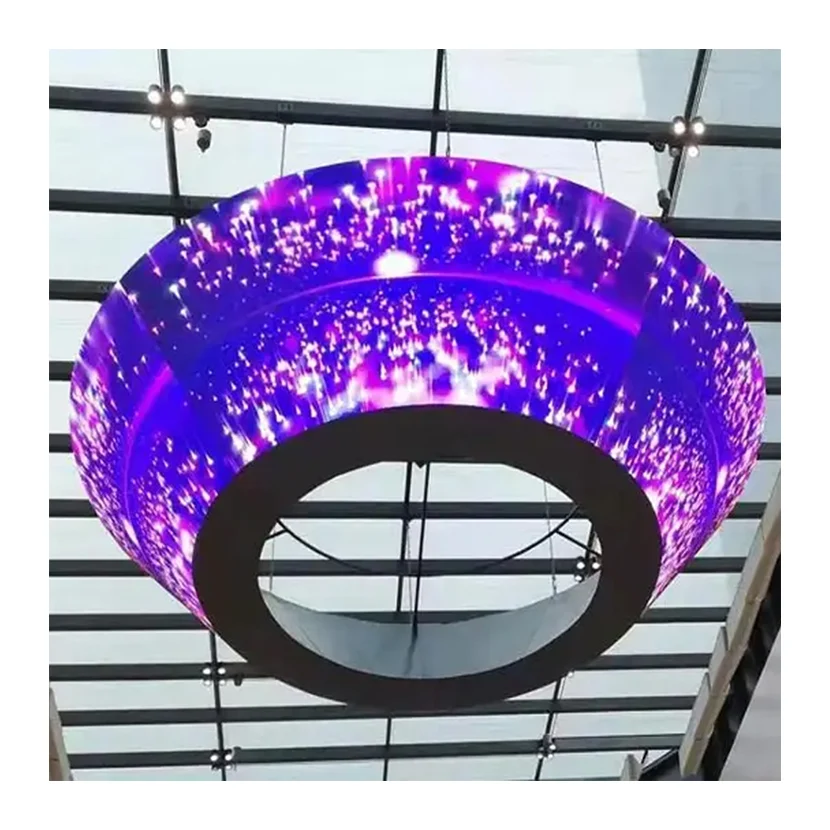
Hemispherical LED displays are far more complex than standard flat LED video walls. Their curved geometry introduces additional challenges in structure, module manufacturing, heat dissipation, signal synchronization, and visual calibration.
To achieve a smooth, seamless, and visually immersive hemispherical LED screen, the following technical factors are critical.
The most important requirement for a hemispherical LED display is accurate curvature forming.
LED modules designed for flat installations cannot simply be bent into shape during assembly. Forced bending often leads to:
Professional hemispherical displays use:
This ensures the sphere maintains a smooth and natural surface without distortion.
A hemisphere requires specialized module geometry, especially around the outer edges.
Standard rectangular LED modules cannot perfectly match a spherical contour. To solve this, manufacturers typically use:
Without proper edge processing, the display may show:
Precision edge adaptation is essential for achieving a clean spherical appearance.
Unlike flat screens, hemispherical LED displays are viewed from many different angles simultaneously.
This creates higher requirements for:
Improper calibration can result in:
Fine-tuning is especially important for:
The goal is to maintain consistent image quality from every viewing position.
The supporting structure is one of the core engineering elements of a hemispherical LED screen.
Because the display surface is curved and weight distribution is uneven, the system requires:
The structural framework must prevent:
Professional designs should also support multiple installation methods, including:
Heat management becomes more difficult in hemispherical structures because the interior often behaves like a semi-enclosed cavity.
Without proper airflow planning, heat accumulation can:
Recommended thermal strategies include:
Thermal management should be considered early in the structural design phase.
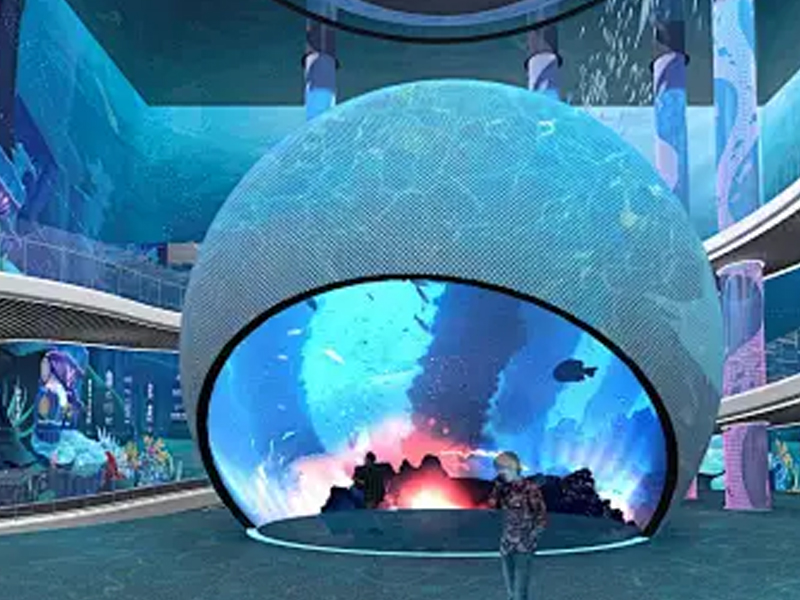
Many hemispherical LED installations are used in:
These environments often experience condensation and humidity changes.
To protect the display:
Moisture intrusion can easily cause:
Proper sealing significantly improves long-term reliability.
Cable management inside a hemisphere is more difficult than in flat installations because all wiring must follow the curved geometry.
Good wiring design should ensure:
Poor cable management can create:
Clean internal routing also improves airflow and serviceability.
Calibration is critical for immersive spherical displays.
Because the display wraps around a curved surface, standard flat-screen calibration methods are often insufficient.
Professional hemispherical systems require:
Advanced calibration helps eliminate:
The final result should appear as one continuous seamless image.
During installation, the central curvature reference point must be accurately established.
Even minor alignment errors can cause:
Installers typically use:
Precise alignment ensures the hemisphere maintains a symmetrical and visually balanced shape.
A hemispherical LED display usually contains many interconnected modules and receiving cards.
If signal synchronization is not properly configured, problems may include:
To maintain smooth playback:
This is especially important for:
Hemispherical LED displays combine complex mechanical engineering with advanced visual processing technology.
Successful projects depend on:
Compared with conventional flat LED screens, hemispherical installations demand significantly higher standards in both fabrication and installation. When properly executed, however, they deliver an exceptional immersive visual experience that traditional displays cannot achieve.
 EN
EN
 AR
AR
 BG
BG
 HR
HR
 CS
CS
 DA
DA
 NL
NL
 FI
FI
 FR
FR
 DE
DE
 EL
EL
 HI
HI
 IT
IT
 JA
JA
 KO
KO
 NO
NO
 PL
PL
 PT
PT
 RO
RO
 RU
RU
 ES
ES
 SV
SV
 TL
TL
 ID
ID
 SR
SR
 UK
UK
 VI
VI
 ET
ET
 HU
HU
 TH
TH
 TR
TR
 FA
FA
 AF
AF
 MS
MS
 GA
GA
 HY
HY
 AZ
AZ
 MN
MN
 UZ
UZ