Home > News > Industry News
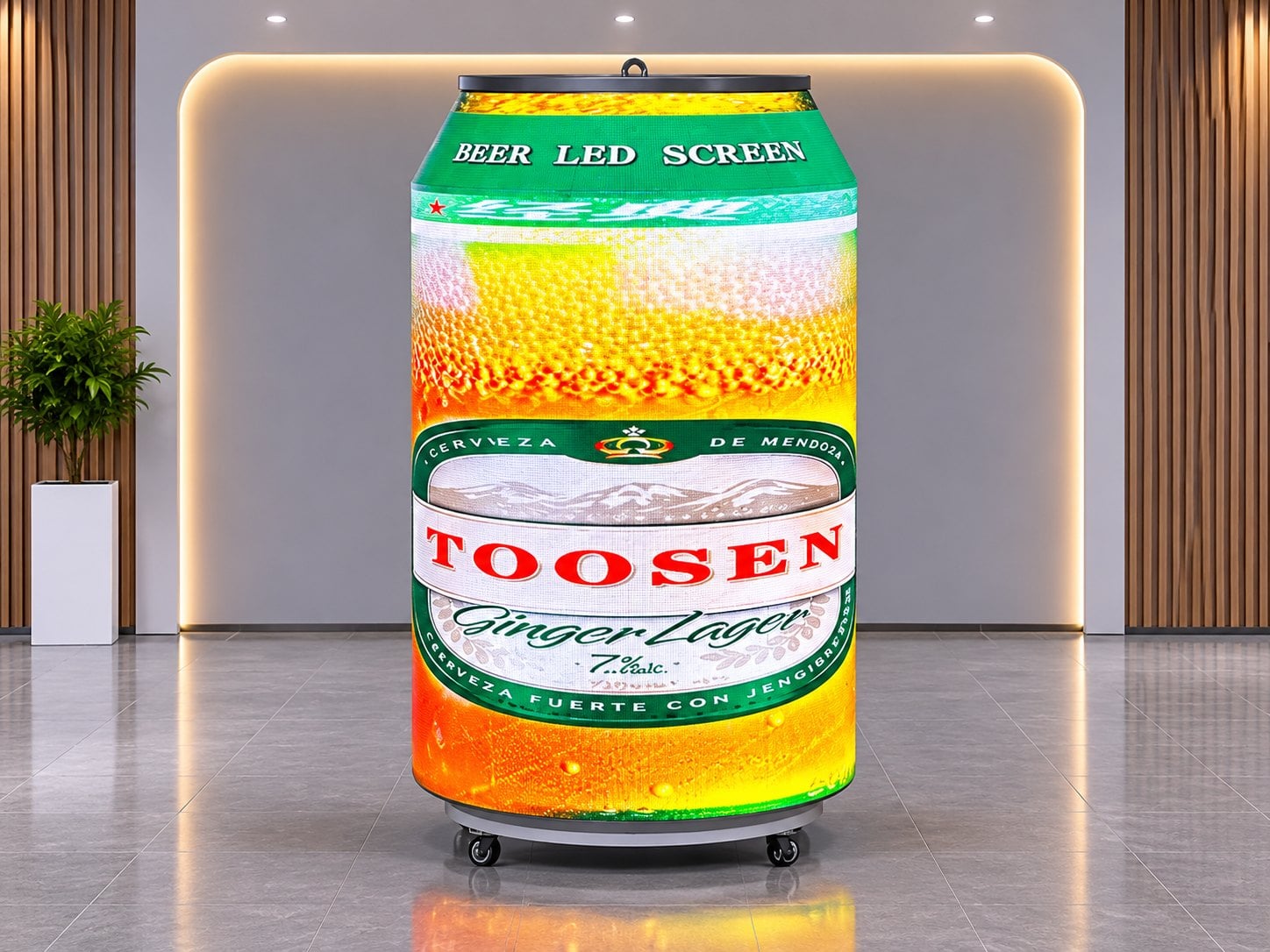
A bottle-shaped LED display has a different internal structure from a standard flat LED screen. Its narrow neck, curved shoulder, wide body and bottom section create several different installation spaces.
During operation, these areas may not produce or release heat at the same rate. Some sections may remain relatively cool, while others develop local hotspots.
If these temperature differences are not identified early, excessive heat may affect driver ICs, power supplies and LED modules. Over time, this can increase component stress and cause brightness inconsistency, color changes or unexpected display failures.
Thermal mapping provides a practical way to understand how heat is distributed across the entire bottle-shaped LED display.
A bottle-shaped LED screen should not be treated as one uniform thermal area. Engineers can divide its surface into four main zones.
Bottle Neck: The narrow neck often has limited internal space. Power cables, connectors and supporting components may be concentrated here, making ventilation more difficult.
Shoulder Area: The curved transition between the neck and body can create irregular gaps inside the structure. Components installed close to the frame may experience different heat-transfer conditions.
Main Body: This section usually contains a larger number of LED modules. Higher display loads and concentrated electrical components may create local temperature differences.
Bottom Section: The base may contain power supplies, receiving cards and other electrical components. If warm air cannot escape easily, heat may accumulate around these devices.
Checking these four zones separately helps engineers locate problems that could be hidden by measuring only the average temperature.
Several factors can contribute to hotspots in a bottle-shaped LED display.
Uneven component distribution: Power supplies and driver components placed too close together can create concentrated heat sources.
Restricted airflow: Internal brackets, cables and narrow spaces may block natural air movement.
Different module densities: Areas with more electronic components may generate more heat under similar operating conditions.
Uneven operating loads: Brightness settings and image content can change power consumption across different sections.
Installation conditions: A display installed close to a wall or inside an enclosed retail structure may have less room for heat to escape.
These factors can work together. For example, a high-load module installed near a restricted ventilation area may become significantly warmer than surrounding sections.
Thermal problems should be addressed according to their actual locations rather than by adding cooling equipment everywhere.
First, review the internal component layout. Avoid concentrating power supplies and other heat-producing components in the narrow neck or bottom section whenever the design allows.
Second, maintain practical airflow channels between the supporting frame and electronic components. Ventilation openings should have clear inlet and outlet paths.
Third, use suitable heat-conducting structural materials. Aluminum supporting components can help transfer heat away from concentrated areas.
Fourth, select cooling methods according to the operating environment. Indoor installations may use natural convection and passive heat dissipation, while larger or higher-power projects may require additional fans or forced-air ventilation.
Finally, check whether cable routing, protective covers or installation brackets are blocking the original airflow design.
Infrared thermal imaging allows engineers to observe temperature differences without touching the LED modules.
A practical thermal mapping procedure includes five steps.
Step 1: Divide the Display into Zones
Mark the neck, shoulder, main body and bottom section. Record the corresponding module positions so that any problem can be located later.
Step 2: Establish Consistent Test Conditions
Set a fixed brightness level and display test content with a known operating load. Record the ambient temperature, installation conditions and operating settings.
Step 3: Run the Display Continuously
Allow the display to operate until temperatures become sufficiently stable for comparison. Record the operating time rather than relying on a single measurement immediately after startup.
Step 4: Capture Infrared Images
Use a thermal camera to inspect each surface zone. Keep the camera distance, angle and measurement settings consistent.
Pay attention to localized temperature peaks around driver ICs, power connections, module edges and internal electrical components.
Step 5: Compare and Record Results
Create a thermal map showing the temperature distribution across all four zones. Compare the highest and lowest readings, identify unusual temperature concentrations and repeat the test after making adjustments.
One important point: reflective surfaces and different material emissivities can affect infrared readings. Engineers should use appropriate measurement settings and, where necessary, verify suspicious readings with contact temperature sensors.
The physical structure of a bottle-shaped LED display directly affects its cooling performance.
Flexible LED modules allow manufacturers to follow curved bottle contours while maintaining the required display shape. However, the supporting frame must also provide sufficient internal space for wiring, electrical components and airflow.
A well-designed structure should consider:
Flexible LED modules matched to the bottle profile.
A supporting frame with suitable heat-transfer properties.
Properly distributed power supplies and control components.
Ventilation openings positioned according to the internal layout.
Accessible electrical components for inspection and maintenance.
The final design should balance appearance, structural stability, heat dissipation and service access.
Consider a beverage brand installing a large bottle-shaped LED display in a shopping mall.
The screen operates for extended hours, showing promotional videos and product animations. During commissioning, engineers find that the bottom section is warmer than the main body.
A thermal map helps narrow down the problem. Further inspection reveals that several electrical components are installed close together and that the ventilation path is partially blocked.
After adjusting the component layout and improving airflow, engineers repeat the thermal test under the same operating conditions.
This approach helps verify whether the changes improve temperature distribution before the display is handed over.
For retail stores, product launches and exhibition spaces, thermal mapping is especially useful because creative displays often operate for long periods in compact installation environments.
TOOSENLED specializes in customized LED display solutions, including bottle-shaped, can-shaped, spherical and other special-shaped screens. Its Shaped LED Display solutions support customized structures for different installation requirements.
For bottle-shaped led projects, module selection, structural design, electrical layout and maintenance access should be considered together.
TOOSENLED provides OEM/ODM customization and technical support for installation, debugging and maintenance. Each project can be developed according to its required dimensions, pixel pitch, application environment and display structure.
By considering thermal management during the design and testing stages, manufacturers can help customers reduce potential operating risks and achieve more stable display performance.
Q1: What is thermal mapping for a bottle-shaped LED display?
Thermal mapping is the process of measuring and recording temperature distribution across different screen areas using infrared cameras or temperature sensors.
Q2: Which area of a bottle-shaped LED display is most likely to overheat?
The neck and bottom sections deserve particular attention because their internal spaces may be limited and electrical components can be concentrated there. However, actual hotspots depend on the specific design.
Q3: How long should a thermal test run?
The display should run long enough for its temperature to approach a stable operating condition. Testing time depends on power consumption, ambient temperature, brightness and installation conditions.
Q4: Can infrared cameras detect LED display hotspots?
Yes. Infrared cameras can identify temperature differences across modules, electrical components and structural areas. Measurement accuracy depends on emissivity settings, surface conditions and camera positioning.
Q5: Does a bottle-shaped LED display always need cooling fans?
No. Some indoor displays can use passive cooling and natural airflow. Fans or other active cooling methods may be necessary for larger installations or environments with higher thermal loads.
Q6: Why should thermal mapping be completed before installation?
Factory testing helps identify uneven temperature distribution before delivery. This allows engineers to adjust component layouts, ventilation paths and cooling arrangements before the display enters actual operation.
 EN
 AR
 BG
 HR
 CS
 DA
 NL
 FI
 FR
 DE
 EL
 HI
 IT
 JA
 KO
 NO
 PL
 PT
 RO
 RU
 ES
 SV
 TL
 ID
 SR
 UK
 VI
 ET
 HU
 TH
 TR
 FA
 AF
 MS
 GA
 HY
 AZ
 MN
 UZ