Home > News > Industry News
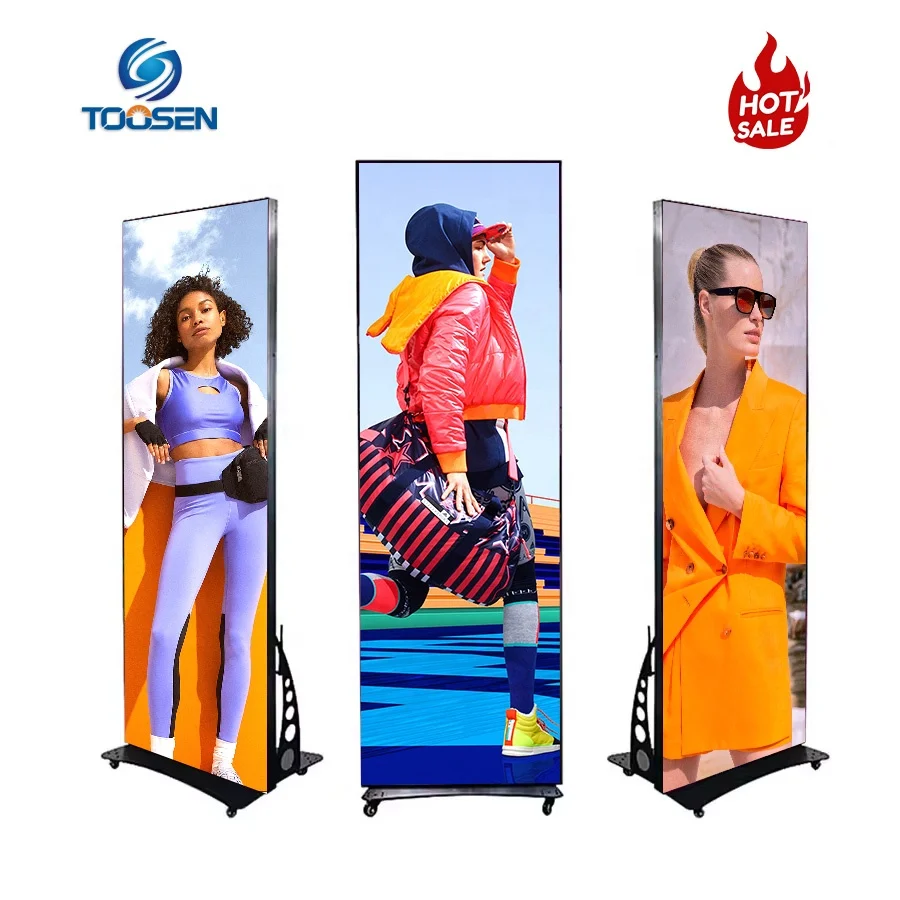
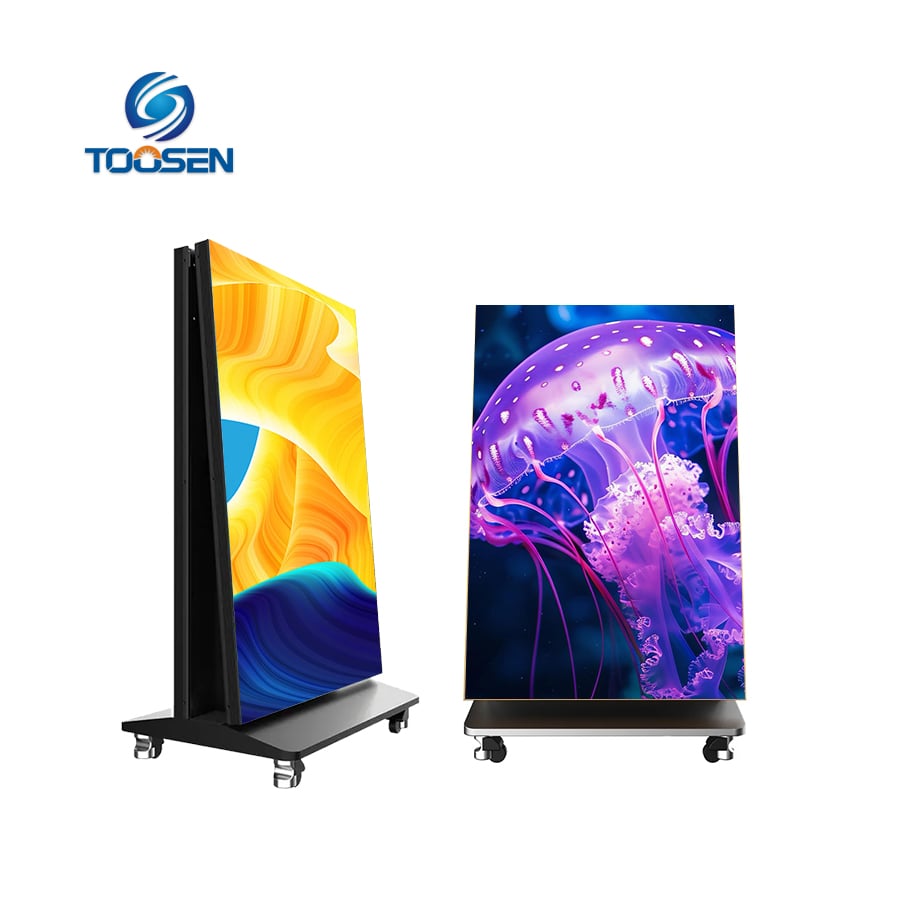
As cities move toward digital transformation, outdoor media must become smarter, more flexible, and more efficient. Smart pole LED screens, also known as lamp post LED screens, smart streetlight displays, or LED digital posters, play a key role in this shift.
Designed specifically for installation on streetlight poles, these outdoor LED displays serve as a core component of smart poles and urban digital infrastructure. Toosen pole LED screens use high-brightness technology to deliver clear visuals in all conditions. With an IP65 or higher protection rating, they resist water, dust, and electrical interference. In addition, network connectivity enables remote cluster control and real-time content updates, making city-wide deployment simple and efficient.
So, why do cities and brands increasingly choose smart pole LED screens?
Smart pole LED screens line up along main roads, intersections, plazas, and public spaces. Because both pedestrians and drivers pass by continuously, brands achieve consistent and repeated exposure throughout the day.
Unlike high-rise billboards, lamp post LED screens sit close to eye level. This placement naturally attracts attention and delivers a much higher content capture rate.
With brightness levels above 6000 cd/m² and automatic light sensors, smart pole LED screens remain clearly visible under strong sunlight, cloudy skies, or nighttime conditions.
Operators can schedule content by time and location. For example, restaurants can promote breakfast deals in the morning, while shopping malls can push event ads during evening rush hours. As a result, messages reach the right audience at the right time.
Smart pole LED screens support synchronized playback across hundreds of units. When multiple screens show the same content simultaneously, they create a strong visual rhythm along streets and public spaces. This coordination greatly enhances brand recall and city image.
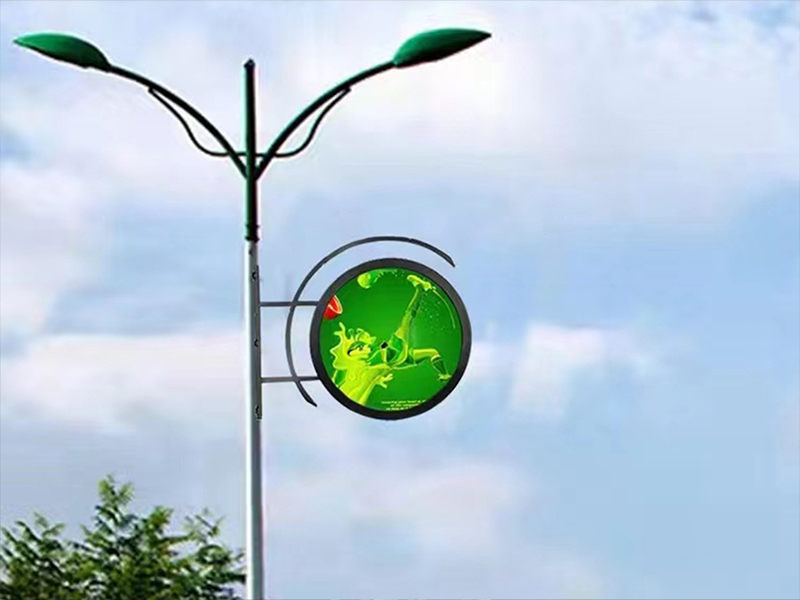
The table below highlights the key differences between lamp post LED screens and traditional wall-mounted outdoor LED displays:
| Category | Smart Pole LED Screen | Traditional Outdoor LED Screen (Wall-Mounted) |
|---|---|---|
| Design Purpose & Core Use | Independent, multi-directional communication. Designed for standalone pole installation along roads, squares, and fences to deliver information from multiple angles. | Dependent, single-direction communication. Installed on building facades for large-scale advertising or information display. |
| Installation Method & Structure | Supported by poles. The screen connects to one or more dedicated columns fixed to a concrete foundation. Installation remains flexible and independent of buildings. | Supported by walls. The screen mounts to a building facade using steel structures and relies on the building’s load-bearing capacity. |
| Structural Strength & Wind Resistance | Very high requirements. As a fully exposed structure, it must withstand wind from all directions. Pole diameter, foundation depth, and cabinet rigidity are critical. | Relatively lower requirements. The building wall absorbs part of the wind load, reducing structural stress on the screen. |
| Viewing Angles | Often double-sided or triple-sided to maximize visibility in multiple directions. Single-sided versions also exist. | Mostly single-sided, facing a fixed direction of pedestrian or vehicle traffic. |
| Viewing Distance & Clearance | Medium to long viewing distance. Installed along roads with sufficient clearance below to ensure safety and visibility for moving viewers. | Short to medium viewing distance. Typically positioned closer to the ground or integrated with building entrances. |
| Power Consumption & Distribution | Lower overall power use. Screen size stays moderate due to pole structure limits. Power is routed from ground level to the pole top. | Potentially very high power consumption, especially for large building-scale displays, requiring dedicated electrical and cooling systems. |
| Installation Complexity & Cost | Higher structural cost due to poles and deep foundations, but flexible placement and controlled timelines. | High civil and steel structure costs, often involving building modifications and longer approval processes. |
In summary, smart pole LED screens combine high visibility, precise content control, and urban-friendly design. They integrate seamlessly into city infrastructure while offering brands a scalable and measurable advertising solution. For smart cities, they are not just displays—they are digital touchpoints.
1. What is a smart pole LED screen?
A smart pole LED screen is an outdoor LED display designed for installation on streetlight poles, supporting digital advertising, public information, and smart city applications.
2. Are lamp post LED screens suitable for outdoor environments?
Yes. With IP65 or higher protection, high brightness, and weather-resistant design, they perform reliably in rain, dust, heat, and strong sunlight.
3. Can smart pole LED screens be managed remotely?
Yes. Most systems support network-based remote management, allowing operators to update content, schedule playback, and control multiple screens in real time.
 EN
EN
 AR
AR
 BG
BG
 HR
HR
 CS
CS
 DA
DA
 NL
NL
 FI
FI
 FR
FR
 DE
DE
 EL
EL
 HI
HI
 IT
IT
 JA
JA
 KO
KO
 NO
NO
 PL
PL
 PT
PT
 RO
RO
 RU
RU
 ES
ES
 SV
SV
 TL
TL
 ID
ID
 SR
SR
 UK
UK
 VI
VI
 ET
ET
 HU
HU
 TH
TH
 TR
TR
 FA
FA
 AF
AF
 MS
MS
 GA
GA
 HY
HY
 AZ
AZ
 MN
MN
 UZ
UZ