Home > News > Industry News
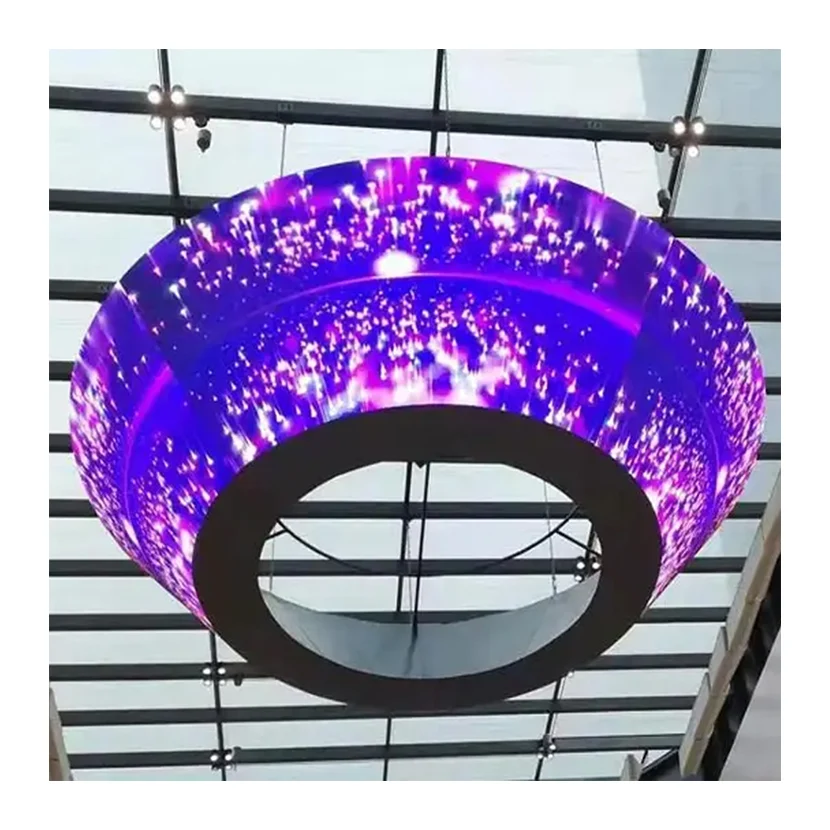
Cylindrical LED displays create eye-catching visual experiences in shopping malls, exhibitions, museums, airports, and retail stores. Their 360-degree visibility helps brands attract attention from every direction. However, like any LED display system, cylindrical LED screens can occasionally experience signal loss, flickering, or unexpected blackouts.
When these issues occur, many users assume the LED modules have failed. In reality, signal loss often originates from the control system, data transmission network, power distribution, or receiving cards.
Understanding the root causes can help operators reduce downtime and maintain stable performance.
Signal-related issues can appear in several ways:
In some cases, the screen recovers automatically after a few seconds. In others, technicians must manually locate and resolve the fault.
Because cylindrical LED displays rely on multiple cabinets connected in sequence, even a small issue can affect a larger portion of the screen.
Every cylindrical LED screen depends on a complete signal chain.
Media Player
      ↓
Video Processor
      ↓
Sending Card
      ↓
Network Cable
      ↓
Receiving Card
      ↓
LED Cabinets
Each component plays a critical role. Therefore, if any connection becomes unstable, the display may lose signal or show abnormal content.
Data transmission issues remain one of the most common causes of signal loss.
Unlike flat LED walls, cylindrical LED displays require cabinets to wrap around a curved structure. As a result, installers often use more inter-cabinet data cables and connectors.
Over time, vibration, maintenance activities, or cable aging can create unstable connections.
Common problems include:
Consequently, the screen may randomly lose communication with certain cabinets.
Receiving cards process data for individual LED cabinets. If a receiving card develops a fault, the affected section may lose image data even though the LED modules remain functional.
Typical symptoms include:
Therefore, technicians should inspect receiving cards whenever signal issues occur repeatedly in the same area.
Many LED display systems rely on firmware to manage communication between hardware components.
Manufacturers regularly release firmware updates that improve stability and fix known bugs. However, some operators continue running older firmware versions for years.
As a result, communication errors may appear unexpectedly.
Updating firmware often resolves:
For this reason, firmware verification should be part of every troubleshooting process.
Signal loss does not always originate from the signal system itself.
Power instability can produce similar symptoms.
When brightness increases, power consumption rises significantly. If the power supply cannot meet demand, cabinets may temporarily shut down or restart.
This situation often causes:
Therefore, technicians should always inspect both power and signal systems simultaneously.
Large cylindrical LED displays often use long cable runs between controllers and cabinets.
As cable length increases, signal quality may decrease.
Poor-quality cables can introduce:
To improve reliability, many professional installers choose high-quality shielded Cat6 or Cat6A cables with pure copper conductors.
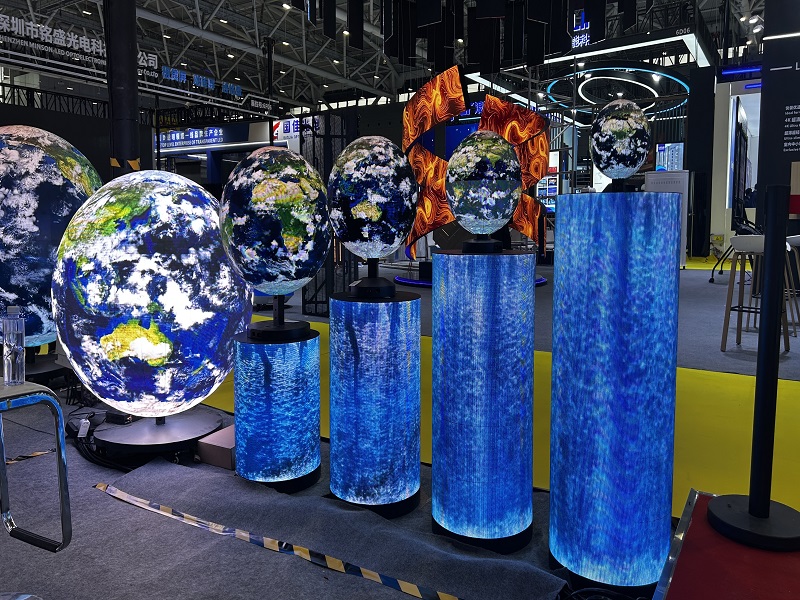
Although signal loss can occur on any LED screen, cylindrical designs introduce additional complexities.
A cylindrical display typically consists of multiple curved cabinets connected in a circular arrangement.
More cabinets mean:
As a result, proper cable management becomes even more important.
Many cylindrical LED screens feature compact structures.
The limited interior space can create challenges such as:
Over time, these conditions may accelerate wear on cables and connectors.
Many cylindrical LED displays operate in public environments for extended periods.
Common applications include:
Because these displays often run for long hours every day, their components experience greater operational stress.
Regular inspection helps prevent small issues from becoming major failures.
A proactive maintenance strategy significantly improves system reliability.
Check all:
Replace damaged components before they cause interruptions.
Review firmware versions periodically and install manufacturer-approved updates when available.
Updated firmware often improves communication stability and system performance.
Ensure each cabinet receives stable voltage.
In addition, avoid overloading individual power circuits during high-brightness operation.
Investing in professional-grade cables reduces transmission errors and improves long-term reliability.
Routine inspections help technicians identify:
Early detection minimizes downtime and repair costs.
Signal loss in cylindrical LED displays rarely originates from the LED modules themselves. Instead, most issues stem from data transmission, receiving cards, firmware, power distribution, or cable quality.
By understanding how the system operates and implementing regular maintenance procedures, operators can quickly identify faults and maintain stable performance.
Whether installed in a shopping mall, exhibition center, museum, or retail environment, a well-maintained cylindrical LED display delivers reliable 360-degree visual experiences while minimizing unexpected signal interruptions.
 EN
EN
 AR
AR
 BG
BG
 HR
HR
 CS
CS
 DA
DA
 NL
NL
 FI
FI
 FR
FR
 DE
DE
 EL
EL
 HI
HI
 IT
IT
 JA
JA
 KO
KO
 NO
NO
 PL
PL
 PT
PT
 RO
RO
 RU
RU
 ES
ES
 SV
SV
 TL
TL
 ID
ID
 SR
SR
 UK
UK
 VI
VI
 ET
ET
 HU
HU
 TH
TH
 TR
TR
 FA
FA
 AF
AF
 MS
MS
 GA
GA
 HY
HY
 AZ
AZ
 MN
MN
 UZ
UZ