Selecting and deploying a spherical LED display requires a structured approach. You must evaluate three core dimensions—environment (indoor vs. outdoor), size and specifications, and installation engineering—to achieve optimal visual performance and long-term operational safety.
1. Indoor vs. Outdoor: Define the Operating Environment
The installation environment fundamentally determines the technical configuration. Brightness, protection level, and visual precision vary significantly between indoor and outdoor scenarios.
Key Differences at a Glance
|
Criteria
|
Indoor Environment
|
Outdoor Environment
|
|
Brightness
|
800–1500 nits. Balanced brightness to avoid glare in controlled lighting.
|
≥5000 nits; ideally 8000–10000 nits under direct sunlight.
|
|
Protection Rating
|
Basic protection is sufficient; no strict waterproofing required.
|
Minimum IP65. Must resist water, dust, and UV exposure.
|
|
Display Precision
|
Prioritize high resolution and fine pixel pitch for close viewing.
|
Focus on long-distance visibility and cost efficiency.
|
|
Cooling & Noise
|
Passive cooling preferred; noise <30 dB for quiet environments.
|
Active cooling (fans) required; higher noise tolerance.
|
Product Type Recommendations
-
Outdoor applications:
Cabinet/module-based displays (high resolution, easy maintenance), point-light source displays (high transparency, lightweight), and mesh/grid screens (excellent heat dissipation and wind resistance).
- Indoor applications:
-
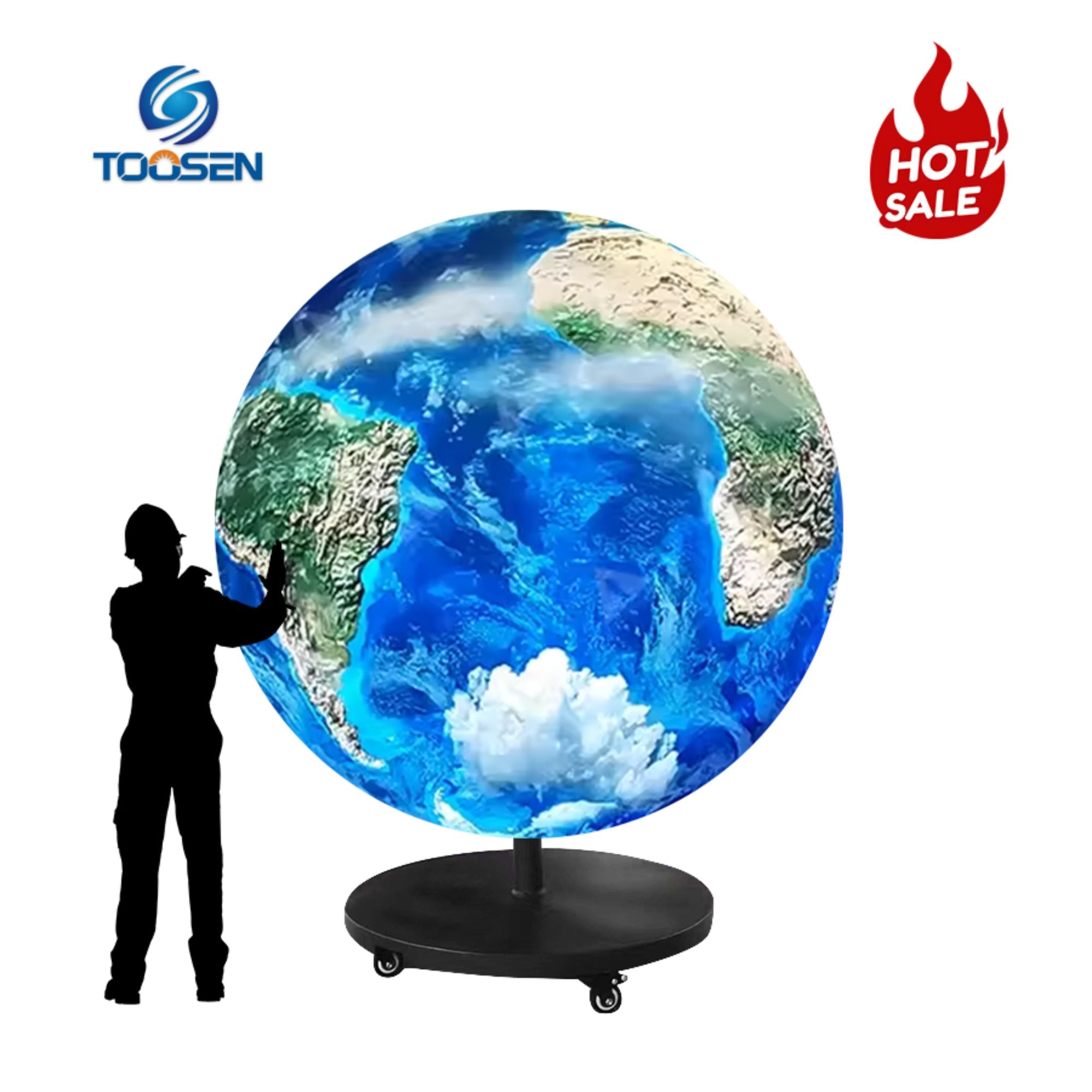
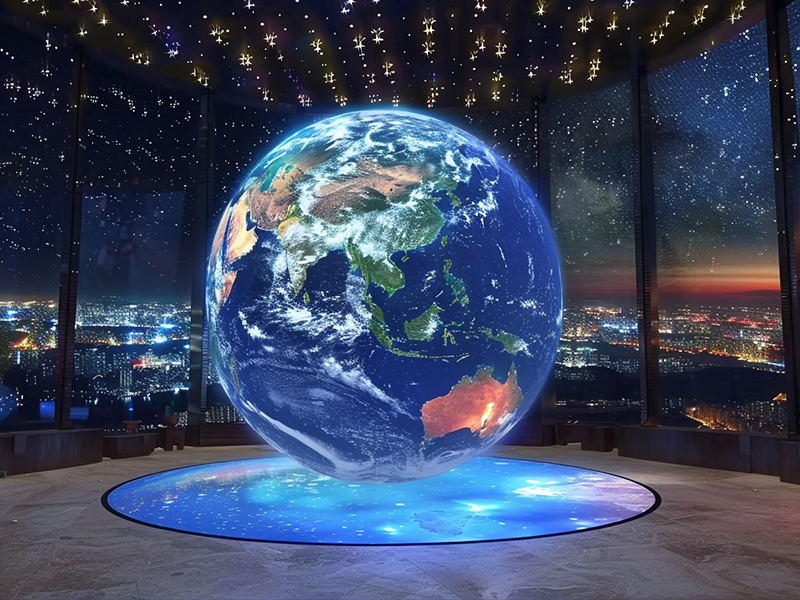
External viewing spheres: Focus on image quality and surface uniformity.
-
Internal dome (immersive) spheres: Designed for audiences inside the structure (e.g., planetariums), emphasizing full immersion.
2. Size and Model Selection: Align with Space and Viewing Distance
Choosing the Right Size
You should match the sphere diameter to the physical space and viewing distance to maintain visual balance.
Indoor Spaces
- Small spaces → Diameter: 1–2 meters | Viewing distance: 3–5 meters
- Medium spaces → Diameter: 2–5 meters | Viewing distance: 5–10 meters
- Large spaces → Diameter: 5 meters or more
Outdoor Spaces
- Small outdoor areas → Diameter: 3–5 meters
- Large plazas / landmarks → Diameter: 5–10 meters or even larger
A mismatch in scale can reduce impact—too large creates visual pressure, while too small fails to stand out.
Pixel Pitch (P Value): The Core Clarity Metric
Pixel pitch directly defines image sharpness and cost. A practical industry rule is:
Optimal viewing distance (meters) ≈ Pixel pitch (mm) × 3
Selection Guidelines:
-
Close-range viewing (indoor exhibitions, conference rooms):
Choose fine pitch (P1.2, P1.5, P2.5) for smooth, pixel-free visuals.
-
Mid-range viewing (shopping malls, atriums):
Use medium pitch (P3, P4) to balance clarity and budget.
-
Long-range viewing (outdoor squares, landmarks):
Select larger pitch (P6, P8, P10). This reduces cost while maintaining acceptable visual quality.
3. Installation Considerations: Safety and Precision First
Installing a spherical LED display is a complex engineering task. Structural integrity and system reliability must take priority.
Structural Safety: The Non-Negotiable Foundation
-
Load-bearing assessment:
Always verify that the installation surface (ceiling, wall, or ground) can support the total weight, including dynamic loads such as wind and vibration.
Never mount directly on non-load-bearing structures like steel sheets or glass facades.
-
Wind and seismic resistance:
For outdoor installations, the steel structure must withstand extreme weather (e.g., typhoon-level winds). Use hot-dip galvanized steel and reinforced concrete foundations (typically ≥1.5 m depth).
-
Lightning protection and grounding:
Outdoor systems require independent grounding with resistance ≤4Ω to prevent lightning damage.
Professional Installation and Calibration
-
Precision assembly:
Spherical displays consist of many irregular modules. Installation tolerance must stay within 1–2 mm to avoid visible seams or surface distortion. This demands experienced technicians and specialized tools.
-
Thermal management:
The enclosed spherical structure tends to trap heat. Therefore, you must implement effective cooling strategies—such as internal airflow systems that create a chimney effect.
Maintain internal temperatures below 45°C to protect LED lifespan and performance.
Power Supply and Signal Stability
-
Stable power distribution:
Use dedicated power systems with sufficient capacity. Balance three-phase loads to prevent voltage fluctuations.
-
Signal interference prevention:
Separate power cables from signal cables. Avoid bundling them together, as electromagnetic interference can cause flickering or signal loss.
4. Work with a Qualified Professional Team
Given the complexity of spherical LED installations, execution quality directly impacts safety, durability, and visual output. A qualified team ensures:
- Accurate structural design
- Reliable installation
- Proper system integration
- Efficient troubleshooting and maintenance
From concept design to final commissioning, professional support minimizes risk and ensures the display performs as intended.
Final Thoughts
A successful spherical LED project depends on aligning environmental conditions, technical specifications, and engineering execution. When you carefully match brightness, pixel pitch, size, and installation strategy to your application, you create a display that is not only visually striking but also stable, efficient, and durable.
In practice, the best results come from treating the spherical LED display as a system—not just a product.

 EN
EN
 AR
AR
 BG
BG
 HR
HR
 CS
CS
 DA
DA
 NL
NL
 FI
FI
 FR
FR
 DE
DE
 EL
EL
 HI
HI
 IT
IT
 JA
JA
 KO
KO
 NO
NO
 PL
PL
 PT
PT
 RO
RO
 RU
RU
 ES
ES
 SV
SV
 TL
TL
 ID
ID
 SR
SR
 UK
UK
 VI
VI
 ET
ET
 HU
HU
 TH
TH
 TR
TR
 FA
FA
 AF
AF
 MS
MS
 GA
GA
 HY
HY
 AZ
AZ
 MN
MN
 UZ
UZ