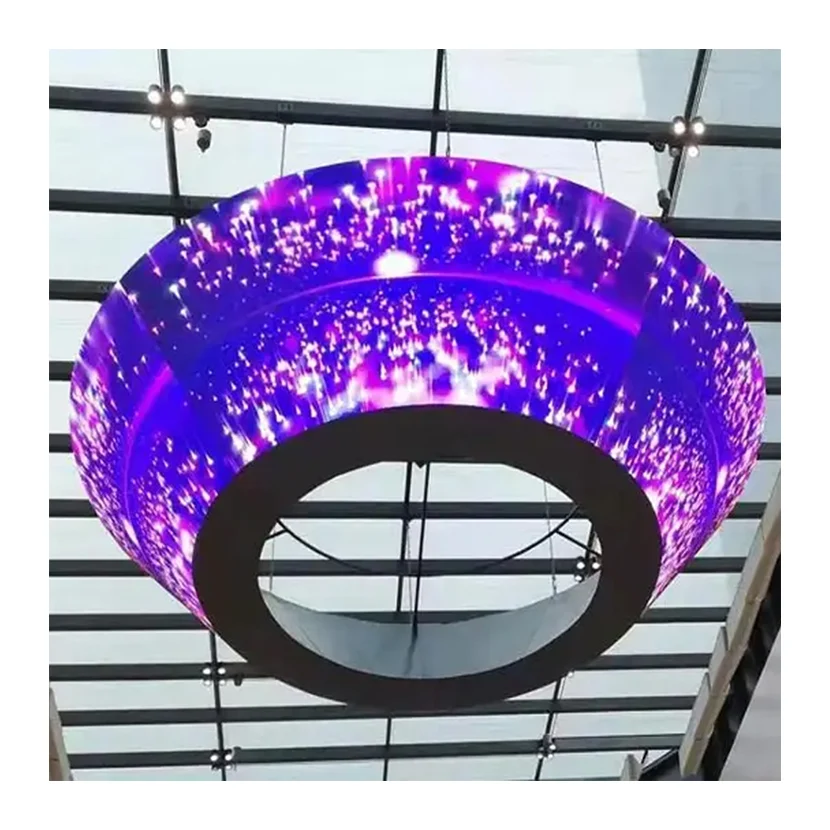
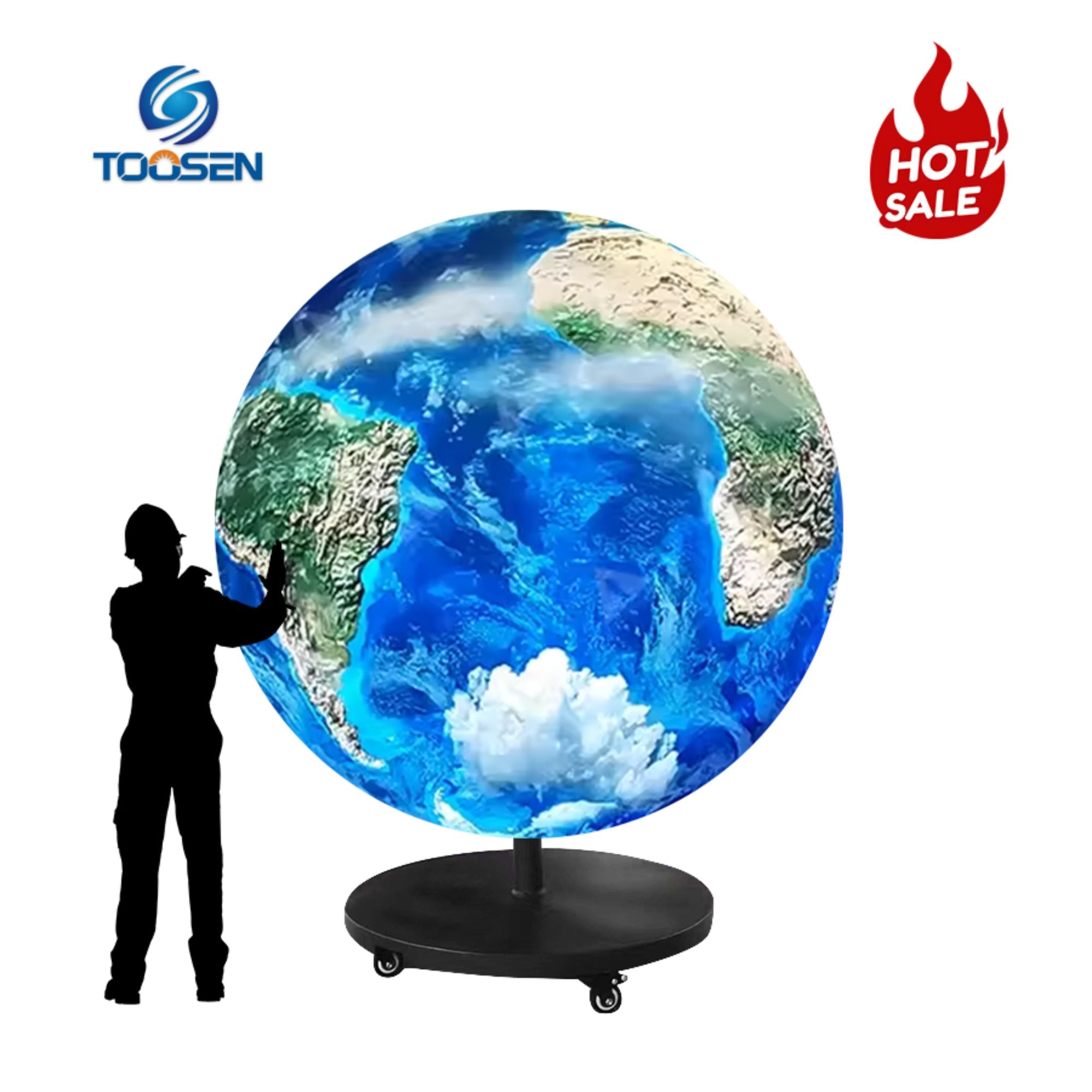
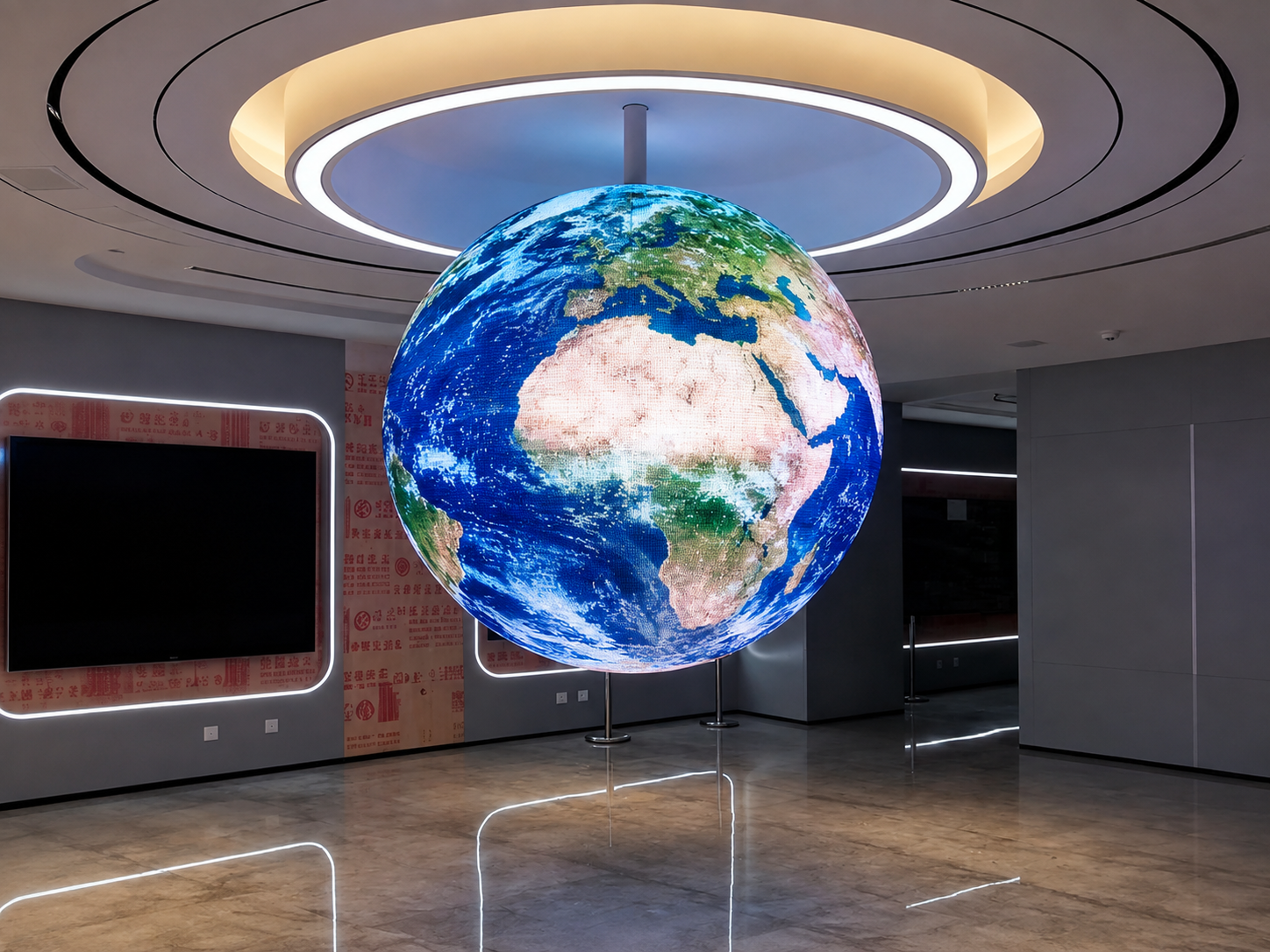
A suspended spherical LED screen can create a strong floating visual effect in shopping malls, museums, airports, exhibition halls and event spaces. However, before hanging a large LED sphere from a ceiling or steel structure, one question must be answered:
How much structural load will the LED sphere add?
The answer is not simply the weight printed on the product specification sheet. The complete suspended load can include the LED modules, internal frame, power supplies, cables, hanging structure and rigging hardware
Understanding these factors before installation makes it easier to design a safe and practical suspension system.
The weight of a spherical LED screen depends on several factors:
A larger sphere normally has much more display area than a smaller sphere.
The surface area of a sphere can be estimated as:
A = πD²
where D is the sphere diameter.
For example, a 2-meter sphere has a surface area of approximately:
3.14 × 2² = 12.56 m²
If the complete display construction weighs approximately 35 kg/m², the basic estimated screen mass would be:
12.56 × 35 ≈ 440 kg
This is useful for an early project estimate, but it should not be treated as the final structural load. Actual product weight should always be confirmed from the final engineering design.
This is one of the most important points when planning a suspended LED display.
If an LED sphere weighs 400 kg, it does not automatically mean that the building engineer only needs to consider 400 kg.
A complete suspended system may include:
Total Suspended Load = LED Sphere + Supporting Frame + Rigging + Cables + Hoists + Other Equipment
For example:
| Component | Example Weight |
|---|---|
| Spherical LED screen | 400 kg |
| Suspension frame | 40 kg |
| Rigging hardware | 20 kg |
| Cables and accessories | 10 kg |
| Estimated total | 470 kg |
This example shows why the complete installation system should be considered rather than the LED modules alone.
Structural engineers normally work with force rather than simply equipment mass.
A simple conversion is:
Force = Mass × Gravity
For a suspended system with a total mass of 470 kg:
470 × 9.81 ≈ 4,611 N
or approximately:
4.61 kN
This represents the basic gravitational load before project-specific structural factors are considered.
It is therefore useful for the LED screen manufacturer to provide accurate equipment weight and suspension information to the structural engineer before installation begins.
The modules form the visible spherical surface. Different pixel pitches and module designs can have different weights.
A spherical LED display cannot maintain its shape without an internal supporting structure.
The frame holds the modules in their correct curved positions and helps distribute loads through the sphere.
Large spheres generally require stronger internal structures.
Steel cables, brackets, lifting rings and other suspension components also add weight.
For large installations, an additional steel hanging frame may be installed between the LED sphere and the building structure.
Power supplies, receiving cards, wiring and other electrical components may be installed inside the sphere.
Their individual weight may be small, but they should still be included in the complete calculation.
Depending on the installation, rigging can include:
The final suspended load therefore includes much more than the LED display surface.
A suspended sphere normally uses multiple suspension points.
Imagine that the complete suspended system weighs 480 kg and uses four suspension points.
A simple early estimate would be:
480 ÷ 4 = 120 kg per point
However, this should not be used as the final engineering value.
Real installations rarely distribute weight perfectly equally.
Several factors can change the load at each point:
For this reason, the manufacturer should provide the equipment drawings and weight information, while a qualified structural or rigging professional determines the required capacity of each suspension point.
Another important question is whether the sphere remains stationary.
A permanently suspended LED sphere mainly creates a static load during normal operation.
However, some creative installations use motors or hoists to raise, lower or move the sphere.
When the sphere accelerates or stops, additional forces can be created.
Therefore, a motorized spherical LED installation should not be evaluated in exactly the same way as a permanently fixed hanging sphere.
The lifting system, hoists, supporting structure and control system all need to be considered during engineering.
Diameter has a major influence on total weight.
Consider the approximate surface areas:
| Diameter | Sphere Surface Area |
| 1 m | 3.14 m² |
| 1.5 m | 7.07 m² |
| 2 m | 12.57 m² |
| 2.5 m | 19.63 m² |
| 3 m | 28.27 m² |
A 3-meter sphere does not have only three times the display area of a 1-meter sphere. It has approximately nine times the surface area.
As diameter increases, the supporting frame may also need to become stronger.
This is why large suspended spheres require more structural planning.
Before approving a suspended spherical LED screen, the project team should prepare several pieces of information:
Providing this information early can prevent major structural changes later in the project.
Possibly, but it should never be assumed.
A shopping mall ceiling, exhibition hall roof or airport structure may appear strong enough, but decorative ceiling panels are not necessarily structural suspension points.
The supporting structure behind the ceiling must be evaluated.
For large spheres, the final installation should be reviewed by qualified structural or rigging professionals according to local requirements.
Toosen manufactures spherical LED displays for indoor and outdoor projects.
Available pixel pitches include P1.25, P1.5, P1.8, P2, P2.5, P3, P4, P5, P6, P8 and P10, with different sphere diameters available according to project requirements.
Suspended installation is particularly suitable for shopping malls, exhibition spaces and airport halls because it saves floor space while maintaining a 360-degree viewing experience.
For customized projects, the diameter, pixel pitch and supporting structure can be designed according to the installation environment.
The structural load of a suspended spherical LED screen should never be estimated from the LED modules alone.
The complete calculation needs to consider the sphere, internal frame, suspension structure, rigging hardware, cables and other attached equipment.
Sphere diameter also matters because display surface area increases rapidly as the diameter becomes larger.
For early planning, equipment weight and basic load calculations can help determine whether a project is practical. Before installation, however, the final suspension points and supporting structure should be verified by qualified engineering professionals.
If you are planning a suspended LED sphere project, providing the sphere diameter, installation height, pixel pitch and suspension conditions to the manufacturer early will make structural design and installation much easier.
It depends on diameter, pixel pitch, frame design and whether the display is designed for indoor or outdoor use. The final project weight should be confirmed with the manufacturer.
There is no single number suitable for every sphere. It depends on sphere size, weight, frame design, center of gravity and supporting structure.
 EN
EN
 AR
AR
 BG
BG
 HR
HR
 CS
CS
 DA
DA
 NL
NL
 FI
FI
 FR
FR
 DE
DE
 EL
EL
 HI
HI
 IT
IT
 JA
JA
 KO
KO
 NO
NO
 PL
PL
 PT
PT
 RO
RO
 RU
RU
 ES
ES
 SV
SV
 TL
TL
 ID
ID
 SR
SR
 UK
UK
 VI
VI
 ET
ET
 HU
HU
 TH
TH
 TR
TR
 FA
FA
 AF
AF
 MS
MS
 GA
GA
 HY
HY
 AZ
AZ
 MN
MN
 UZ
UZ