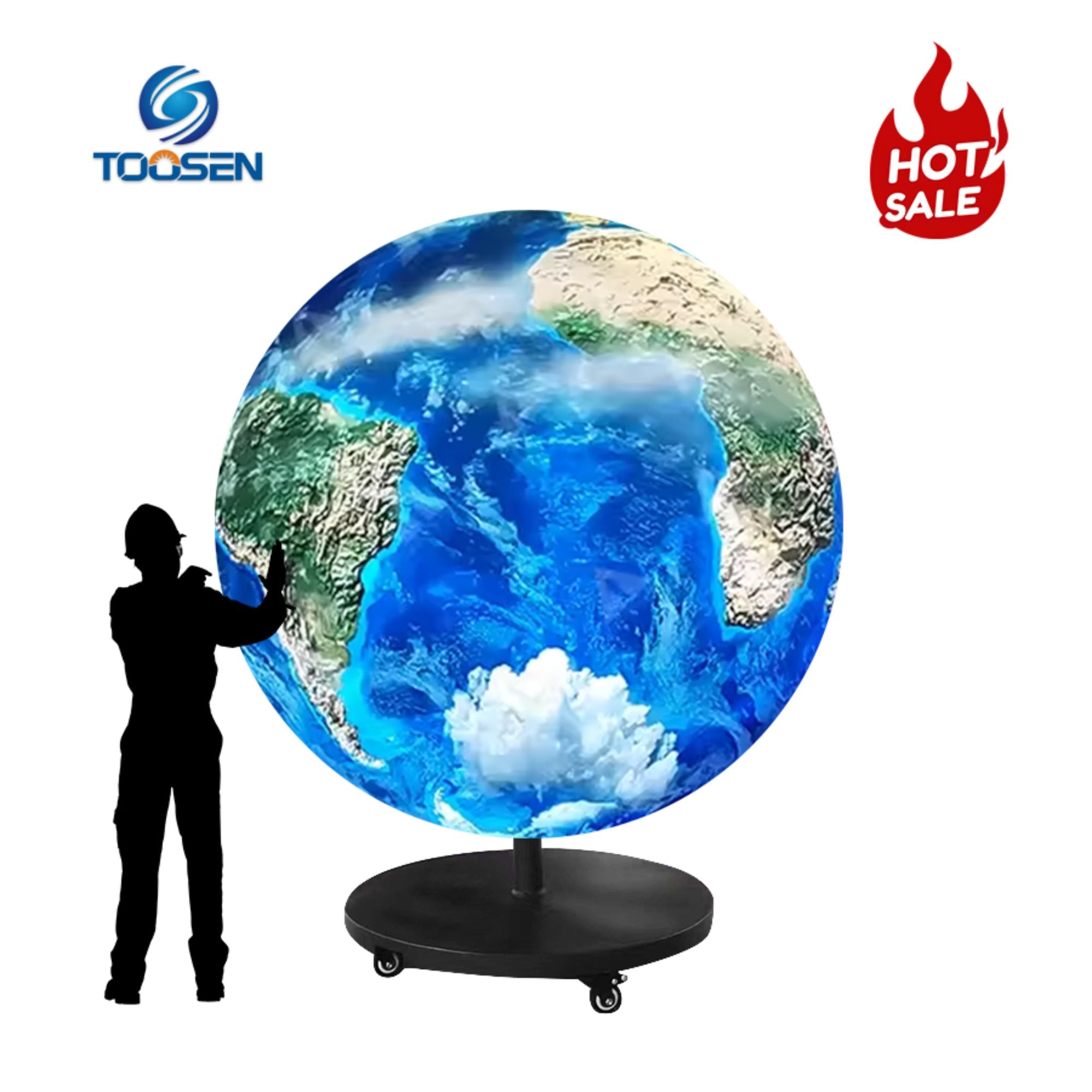
Creating video for a normal LED wall is relatively simple. You know where the left, right, top, and bottom edges are. A spherical LED display is different. Content wraps around a curved 360-degree surface, so a small mistake in the video can become very noticeable once it is mapped onto the sphere.
One of the biggest challenges is creating a loop that viewers cannot easily detect.
Good seamless looping content for LED spheres should solve two problems at the same time: the end of the video must connect naturally to the beginning, and the content must also wrap smoothly around the sphere.
Here is a practical way to create it.
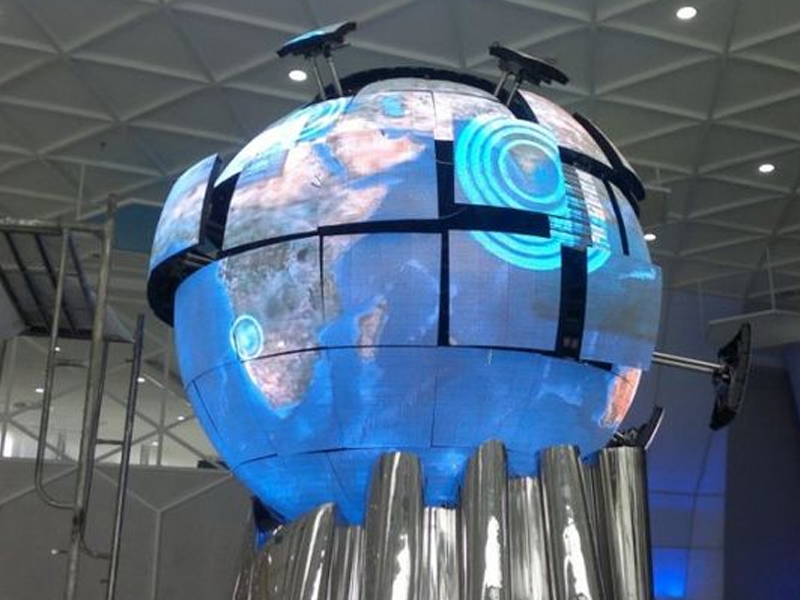
A spherical LED screen can be viewed from many directions. Unlike a traditional rectangular display, it does not have one fixed front viewing area.
This makes repetitive content more obvious.
Imagine a 15-second animation of the Earth rotating. At the end of the video, the Earth suddenly jumps back to its original position. Even if the jump lasts only a fraction of a second, viewers may notice it.
There can also be another problem: a visible vertical line where the two sides of the mapped content meet.
For this reason, a good LED sphere loop needs to handle both time continuity and surface continuity.
Do not start designing before you know the screen specifications.
Ask for:
Sphere diameter and pixel pitch directly affect how much visual detail the display can reproduce.
For example, fine-pitch LED spheres can show more detailed graphics and smaller design elements. Larger pixel pitches are better suited to bold graphics viewed from a greater distance.
If you want to understand this relationship in more detail, see our guide on how LED sphere diameter affects resolution and content.
When designing LED sphere video content, there are two seams to check.
This is the transition between the last frame and the first frame.
If an object finishes in a completely different position from where it started, the animation may jump every time it repeats.
A simple solution is to design cyclic motion from the beginning.
Rotation is a good example. If an object starts at 0 degrees and completes exactly one rotation before the final frame, the next loop can begin naturally.
Particles, flowing lines, waves, clouds, and abstract patterns can also work well.
The second seam exists because flat content must wrap around a spherical surface.
Depending on the mapping method, the left and right sides of your source image may eventually meet on the sphere.
If these edges do not match, a visible line can appear.
Check the left and right edges carefully before exporting the final content. Colors, patterns, brightness, and moving objects should continue naturally across this boundary.
Avoid simply stretching a standard 16:9 video across the screen.
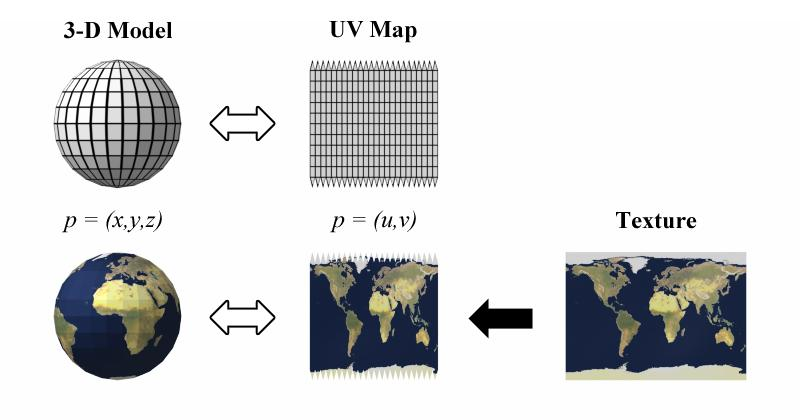
A sphere LED display requires content that follows its actual pixel layout. Depending on the project, this may involve a UV map, equirectangular layout, or a customized pixel-mapping template supplied for the display.
The purpose is simple: you are designing a flat source file that will eventually be wrapped around a three-dimensional object.
Always preview this mapping before final delivery.
A design that looks perfect on your computer monitor may look very different once wrapped around the LED sphere.
The top and bottom of a sphere are difficult areas for content design.
When a flat texture is mapped onto a sphere, content close to the north and south poles can become compressed or distorted.
Avoid placing important elements such as:
directly around these areas.
Instead, use visual elements that can tolerate distortion. Clouds, stars, particles, water, light effects, and abstract textures are usually more forgiving.
Keep logos, text, and key product information closer to the main viewing zones.
The easiest seamless loop is one that was designed to repeat from the beginning.
Instead of finishing one scene and restarting another, think in circles.
Good examples include rotating planets, orbiting objects, flowing particles, moving light bands, repeating geometric patterns, spinning logos, and continuous waves.
For a product advertisement, you might have a bottle slowly rotate while particles move around it. When both motions return to their starting positions at the end of the timeline, the animation can repeat without an obvious cut.
This works especially well for trade shows, shopping malls, museums, retail spaces, and branded installations.
Do not rely only on the flat composition.
Import the content into software that allows you to preview it on a 3D sphere. Blender is useful for checking UV mapping and distortion, while After Effects is commonly used to create looping motion graphics.
During preview, rotate the virtual sphere and inspect it from several angles.
Look for:
Correcting these problems before final output saves time during installation.
A 3D preview is useful, but the final test should always be done on the actual display whenever possible.
A real spherical LED display introduces factors that a desktop preview cannot fully reproduce, including pixel pitch, viewing distance, brightness, physical module layout, and the processing system.
Run the content for several complete loops.
Do not watch only from one position. Walk around the sphere and check the transition from different viewing angles.
If you can immediately identify where the animation restarts, the loop still needs adjustment.
One common mistake is taking an existing rectangular advertisement and stretching it over the sphere. Another is focusing only on the first-to-last-frame transition while ignoring the seam around the surface.
Too much text is another problem. A spherical LED screen is usually better at creating visual impact than displaying long messages.
Also avoid finishing the content without testing it on a spherical preview. The flatter your workflow is, the easier it is to miss distortion.
Simple continuous motion usually works better than complicated scene changes.
Earth animations, galaxy effects, flowing particles, rotating products, abstract graphics, water effects, moving lines, and slow logo rotations are all good choices.
The goal is not simply to fill every pixel. Content should work with the shape of the display.
A well-designed sphere makes viewers feel that the animation belongs to the physical object rather than being a flat video wrapped around it.
Creating seamless looping content for LED spheres requires more than matching the first and last frames.
You also need to consider spatial seams, pixel mapping, pole distortion, resolution, motion direction, and real-screen testing.
Start with the specifications of the LED sphere, build the animation around its geometry, preview the result in 3D, and test the final file on the display.
When these steps are handled correctly, the loop becomes difficult to notice and the spherical screen feels like one continuous digital surface.
AI Display provides customized spherical and irregular-shaped LED display solutions for indoor and outdoor projects. Different diameters, pixel pitches, control methods, and installation structures can be configured according to the project. For content-heavy projects, confirming the screen specifications and pixel mapping before content production can make the entire workflow much easier.
Yes, but the file still needs to match the playback system and pixel-mapping requirements. A normal rectangular video may look distorted if it is not prepared for the spherical surface.
Check both the beginning/end transition and the edges of the mapped content. The first and last frames should connect naturally, while the boundaries that meet on the sphere should also match.
 EN
EN
 AR
AR
 BG
BG
 HR
HR
 CS
CS
 DA
DA
 NL
NL
 FI
FI
 FR
FR
 DE
DE
 EL
EL
 HI
HI
 IT
IT
 JA
JA
 KO
KO
 NO
NO
 PL
PL
 PT
PT
 RO
RO
 RU
RU
 ES
ES
 SV
SV
 TL
TL
 ID
ID
 SR
SR
 UK
UK
 VI
VI
 ET
ET
 HU
HU
 TH
TH
 TR
TR
 FA
FA
 AF
AF
 MS
MS
 GA
GA
 HY
HY
 AZ
AZ
 MN
MN
 UZ
UZ